This page is designed to support regulators of behavior analysts by providing access to key resources, guidance, and services offered by the BACB. Here, you’ll find information about the types of assistance available to regulators and those involved in state licensure processes—such as draft bill reviews, training opportunities, and use of the BACB’s Mass Email Service.
Regulatory agency staff and board members can also learn how to join the BACB Regulators Listserv, a dedicated network for sharing updates and collaborating with peers. In addition, you’ll find access to Regulatory Briefs, helpful documents for regulatory review, and links to important information such as certificant data, verification tools, and published disciplinary actions.
To contact the BACB regarding regulatory matters, please use the contact form at the bottom of the page.
For a list of all US states with behavior analyst licensure laws and links to their corresponding websites, please see our US Licensure of Behavior Analysts page.
Support for Regulators
The BACB supports behavior analyst licensure boards and those pursuing behavior analyst licensure by providing the following resources.
Training Opportunities

The BACB provides initial and ongoing training for regulators upon request. To request a training, use the Regulatory Contact Form.
Mass Email Service

Regulators* can notify BACB certificants in their state of pending legislation, regulations, or procedures using the BACB’s Mass Email Service.
Licensure Exchange Listserv

A private mailing list for regulators** to connect with one another and with the BACB on issues relevant to the regulation of behavior analysts, and to receive updates directly from the BACB. Request access through the Regulatory Contact Form.
Draft Bill Review

Draft bills, regulations, and amendments may be sent through the Regulatory Contact Form for review and feedback.
Regulatory Briefs & Other Resources

The BACB publishes Regulatory Briefs and other informational documents that may be useful in periodic regulatory reviews.
Model Licensure Act

The Association of Professional Behavior Analysts (APBA) provides a Model Licensure Act that is the recommended foundation for any behavior analyst licensure law.
Regulatory Briefs & Documents
Regulatory Briefs
The following Regulatory Briefs cover important information that may be useful to regulators of behavior analysis and those working toward behavior analyst licensure in their state.
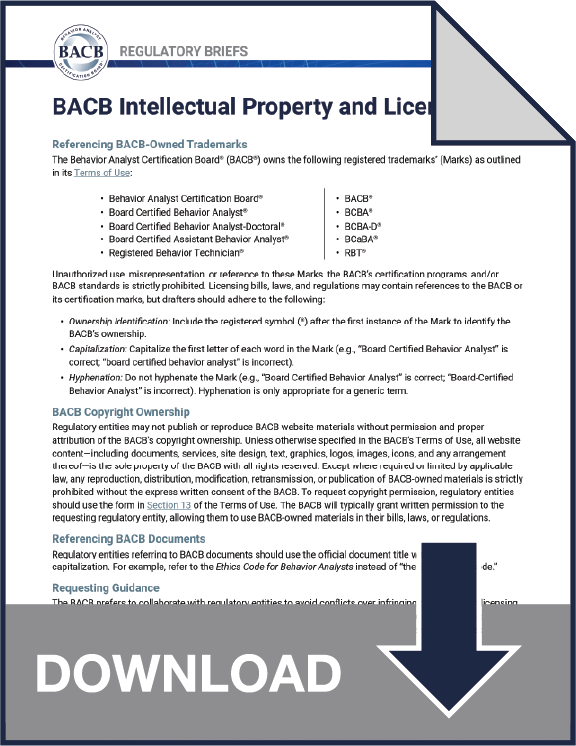
The BACB Intellectual Property and Licensure document outlines the proper use of BACB-owned trademarks and copyrighted materials in licensing laws, including guidelines for capitalization, hyphenation, and attribution. It also details procedures for requesting permission and encourages regulatory entities to collaborate with the BACB to avoid infringement.
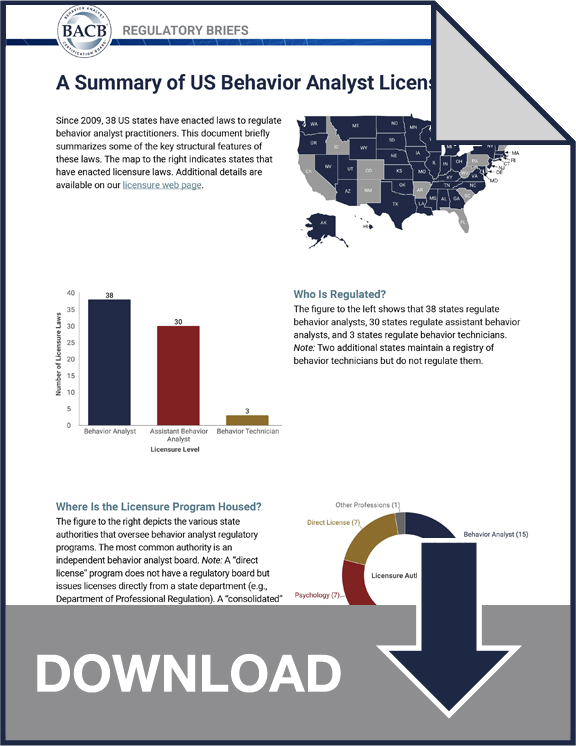
A Summary of US Behavior Analyst Licensure Laws reviews key elements of state licensure laws, including regulated roles, oversight structures, and requirements for continuing education, ethics, and reciprocity.
Documents for Regulatory Reviews
The following documents on the BACB and its certification programs may be useful in periodic regulatory reviews (e.g., sunrise, sunset).
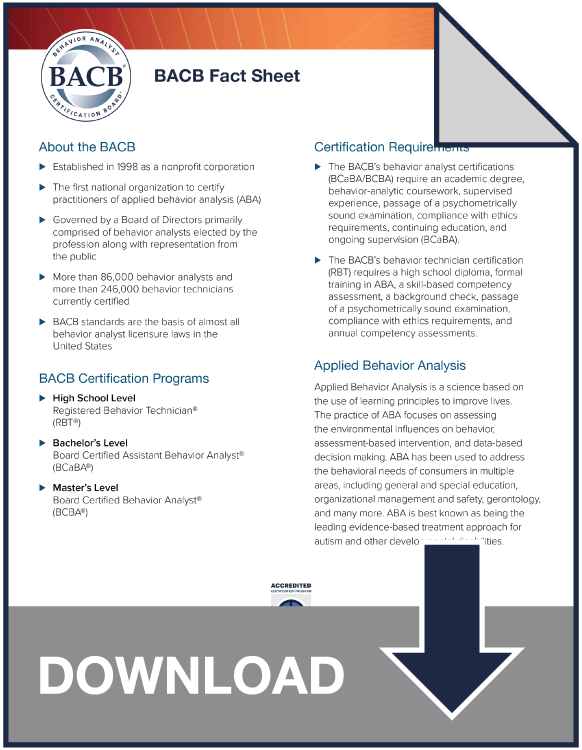
The BACB Fact Sheet outlines the background of the BACB, the certification levels (RBT, BCaBA, BCBA) offered, their respective education and training requirements, and summarizes the role of applied behavior analysis in improving lives across various fields.
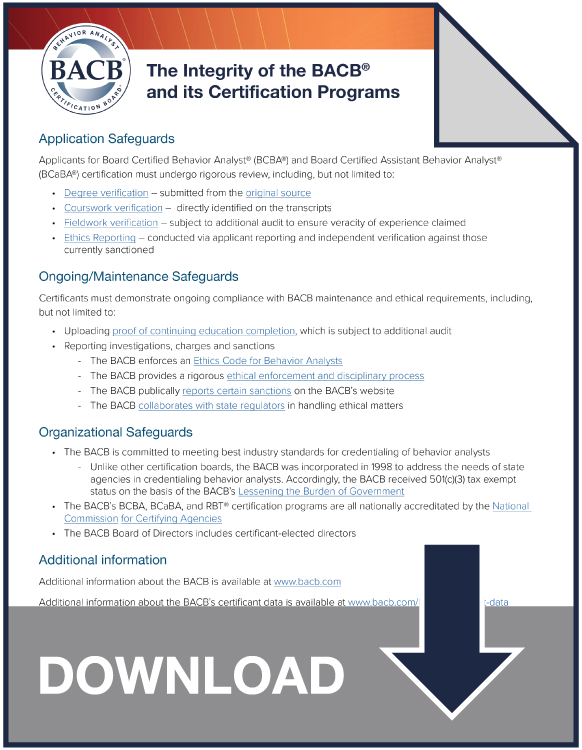
The Integrity of the BACB and Its Certification Programs document outlines safeguards in place to ensure organizational and certification integrity, including application audits, ethics enforcement, continuing education verification, and collaboration with state regulators.
BACB Resources
BACB Certificant Information
Region-specific data are available on our Region Specific Certificant Data page, where regulators can filter certificant data by state or region, certification type, and
time frame.
See a practitioner’s certification status, original certification date, expiration, current location, and whether they have reportable disciplinary actions associated with their certification.