The BACB’s 2025 University Pass Rate Reports are now available for BCBA and BCaBA certification programs. The reports provide first-time examination pass-rate data for qualifying university training programs, as well as new analyses to help prospective students evaluate their options.
Author: BACB NEWS
Call for 2027 Hemingway Award Nominations
The BACB is pleased to call for nominations for the 2027 Michael Hemingway Behavior Analysis Award. In memory of the life and contributions of Michael Hemingway, this annual award honors an individual distinguished for their contributions to public policy related to behavior analysis and/or for their efforts to increase the availability of behavior-analytic services.
Nominations will be accepted until 5:00 p.m. MDT on Tuesday, October 13, 2026.
2027 BCBA and BCaBA Requirements: What You Need to Know
Significant changes to BCBA and BCaBA certification requirements take effect on January 1, 2027. To be reviewed under the current 2022 requirements, your complete application (including payment and all required documents) must be received by December 31, 2026.
To prepare for the transition, explore the 2027 BCBA and BCaBA Requirements, the Guidance for Meeting the BCBA and BCaBA Requirements During the 2027 Transition, the updated BCBA and BCaBA Handbooks, and the podcast episode Understanding the Updates to the 2027 BCBA and BCaBA Requirements.
What is an ACE Provider?
Learn about the Authorized Continuing Education (ACE) program and the role of ACE Providers in this informative overview. This video is based on the requirements that go into effect on July 1, 2026, and explains who can offer ACE events, what content qualifies, and how to verify ACE Providers.
You can find all of the BACB’s videos on our YouTube channel.
Now Available: 2025 RBT Examination Pass Rates for 40-Hour Training Providers
We’ve published the latest RBT examination pass-rate data from publicly available 40-hour training providers. Explore the full report for details.
New BACB Blog Post—RBT Professional Development: In-Service and ACE Events
The BACB has published a new blog post, RBT Professional Development: In-Service and ACE Events.
This post provides an overview of the 2026 RBT professional development requirements, including how RBTs can earn and document professional development units (PDUs) and key differences between in-service training and ACE events. Read the full post to learn more.
RBT Professional Development: In-Service and ACE Events
UPDATED: June 29, 2026
Earning professional development units (PDUs) is a new requirement for RBTs that will begin once they become certified or have recertified in 2026. As first announced in the December 2023 BACB Newsletter, this change was designed to help RBTs build and refine their skills throughout their careers. Professional development (PD) focuses on continuous growth—not just maintaining their current skills but continuing to strengthen them and learn new ones along the way.
In this blog, we’ll walk through:
- The different ways RBTs can earn PDUs
- The similarities and differences between In-Service and ACE events
- General PD requirements
- How to document PDUs
Let’s dive in!
Types of PDUs
After becoming newly certified or recertified in 2026, RBTs are required to earn 12 PDUs during each 2-year recertification cycle. They can earn PDUs through any of the following categories:
- Didactic Behavior-Analytic University Coursework
- In-service training
- ACE PD events
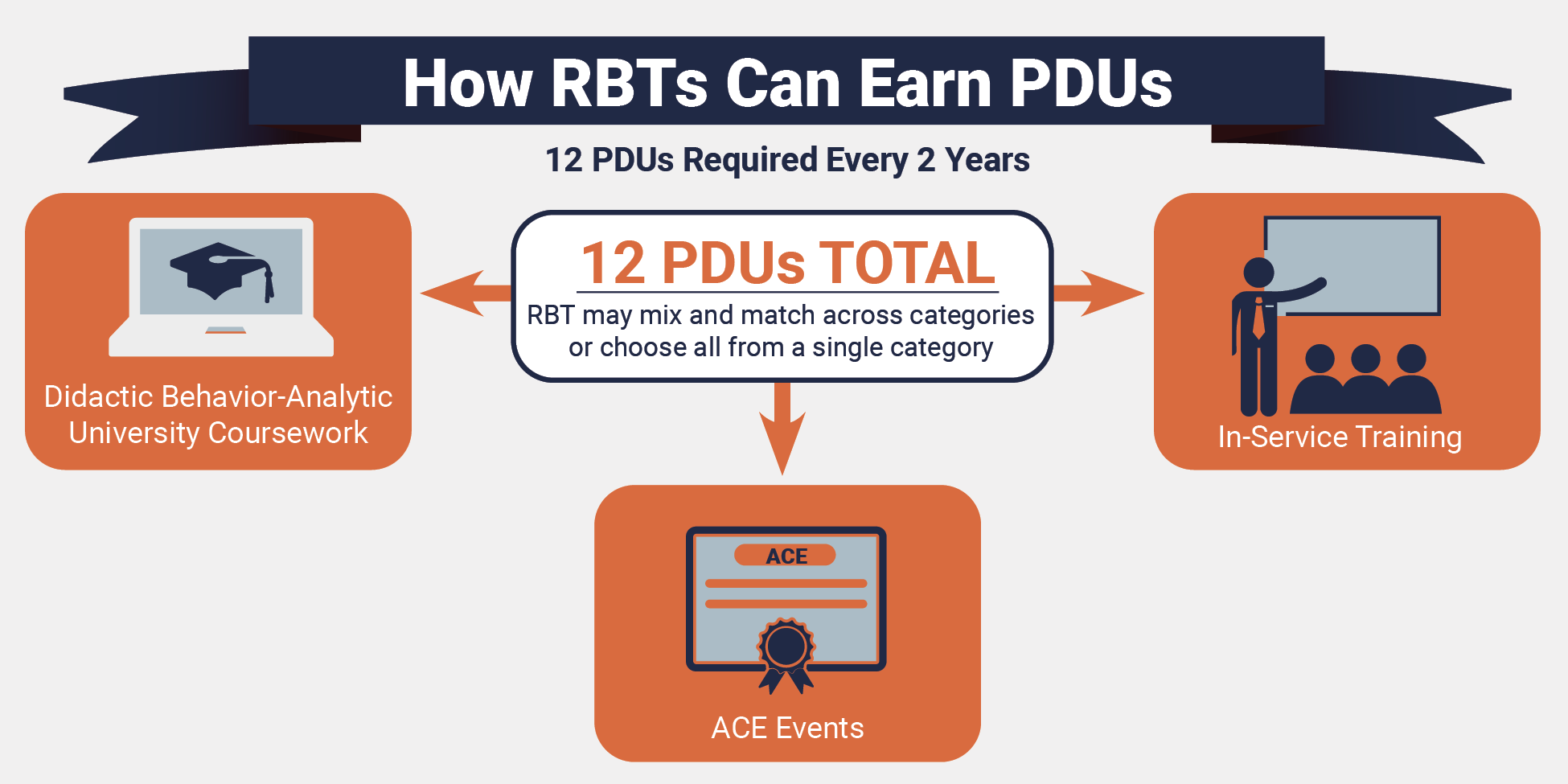
Let’s look at each category:

1. Didactic Behavior-Analytic University Coursework
For RBTs who are currently in college, this option is a win-win. Behavior-analytic university courses can count toward PD requirements as long as:
- the university is accredited,
- the course is behavior-analytic in nature, and
- a grade of “C” or better is earned.
RBTs must upload the following documents in their BACB portal account:
- the course syllabus, and
- the transcript with proof of a passing grade.
One semester credit hour equals 15 hours of classroom instruction—that’s 15 PDUs. For example, a 3-credit-hour course that meets the requirements provides 45 PDUs.
If you’re already enrolled in behavior-analytic courses, such as Foundations of Behavior Analysis or Methods of Behavior Analysis, you may be earning PDUs without even realizing it!

2. Approved Continuing Education (ACE) PD Events
ACE Providers may also offer PD events for RBTs.
To qualify:
- ACE PD events must meet the requirements in the RBT Professional Development for ACE Providers document and the ACE Provider Handbook: Effective July 1, 2026.
- ACE PDUs must be documented using the RBT Professional Development: ACE Event form.
- The RBT will then upload their completed documents in their BACB portal account.
ACE PD events are typically:
- open to any RBTs (depending on the provider)
- offered outside of company time
This option is helpful if an RBT’s organization does not offer in-service PDUs and they are not enrolled in behavior-analytic coursework. These events may be offered in a variety of formats, including online webinars or conferences specifically for RBTs. RBTs and RBT Supervisors can review these events together so the RBT Supervisor can guide them to high-quality, meaningful options. Ideally, the RBT Supervisor will debrief with them after they attend an ACE event to discuss what they learned.

3. In-Service Training
Organizations that employ RBTs can offer qualifying in-service trainings that qualify for PDUs.
To qualify:
- In-Service PD Trainings must meet the requirements outlined in the RBT Professional Development: In-Service Training Requirements document.
- In-Service PDUs must be documented using the RBT Professional Development: In-Service Event form.
- The RBT will then upload their completed documents to their BACB portal account.
In-Service trainings are typically:
- completed during company time
- offered only to RBTs employed by that organization
This PD type allows organizations to directly support their employees’ professional growth. Organizations can also use this as an opportunity to create (or update) their training schedule so that staff training meets the RBT PDU requirements. Another benefit is that organizations can align PDU topics with the services, goals, and situations most relevant to their work (e.g., focused training on academic skill development). This may also allow for follow-up activities and discussions.
In-Service vs. ACE Events: What’s the Difference?
You might be wondering: Are these actually different?
Great question!
The core requirements for both In-Service and ACE PD events are the same (we’ll review those next).
The main differences are logistical:
- In-Service trainings are provided by the organization where the RBT is employed and typically conducted on company time.
- ACE PD events are provided by ACE Providers and may be available to any RBT interested in the event, regardless of where they work.
These two options offer flexibility for both RBTs and the organizations that employ them, helping ensure there are enough meaningful professional development opportunities.
If an organization is both a service provider and an ACE Provider, it can choose the option that works best for its internal training events.

RBT PD Event Requirements
Whether a PD event is In-Service or ACE, it must meet certain standards.
PD Content and Audience
PD events should cover or expand upon:
- the RBT 2026 40-Hour Training Requirements and Curriculum Outline
- the RBT Ethics Code (2.0)
- other BACB requirements
- additional behavior-analytic topics appropriate for RBT practice
PD events are designed specifically for RBTs. Because they focus on foundational RBT-level material, BCBAs and BCaBAs cannot earn continuing education units (CEUs) by attending or teaching RBT PD events. Likewise, RBTs cannot earn PDUs by attending CE events. Those events are designed for BCBAs and BCaBAs and may be too advanced or not relevant to RBT practice.
Different credentials equal different continuing education pathways:
| PD Events | CE Events | |
|---|---|---|
| Content | Covers or expands on material from the RBT 40-hour training, the RBT Ethics Code, or other topics relevant to RBTs | Any aspect of behavior analysis: practice, science, methodology, theory, or the profession itself |
| Skill Level | Focused on foundational and applied RBT skills (e.g., basic behavior-analytic techniques) | Beyond basic behavior-analytic techniques |
| Audience | Designed for RBTs who may have only completed 40 hours of training in behavior analysis | Designed for individuals who have completed bachelor’s or master’s degree coursework in behavior analysis |
| Content Recency | Up-to-date content | Up-to-date content |
Examples of appropriate RBT PD content:
- using best practices for interacting with caregivers of clients
- using the Picture Exchange Communication System (PECS) to communicate with clients
- using best practices for implementing assent-based treatment
- applying evidence-based practices to mitigate work-related stress
- implementing and troubleshooting token economies
- running effective discrete trial teaching sessions
- identifying verbal operants by function and controlling variables
- discriminating between positive and negative reinforcement and punishment
- preparing effectively for service delivery
- following ethical practices for RBTs
Examples of content that does not qualify:
- receiving client- or program-specific training
- reviewing company policies and procedures
- completing BCBA exam prep materials
- attending an ACE event that offers CEUs for BCaBAs and BCBAs
- training on ABA program and data management software
- completing the 40-hour RBT training again (PD topics should expand upon the content from the 40-hour RBT training; see examples above)
- completing CPR training
- attending individual or group supervision meetings about specific client programming
If it’s basic onboarding, company policy, or supervision, it’s probably not a PD event. Additionally, RBT 40-Hour Trainings cannot be repackaged as RBT PD events. However, content that is covered in the RBT 40-Hour Training can be reviewed in more depth or expanded upon to qualify for RBT PD events.
PD Instructors
PD Instructors must hold an active BCaBA, BCBA, or BCBA-D certification.
Co-presenters: Co-presenters may present a portion of a PD event under the direct oversight of a qualified PD Instructor who is present at the event.
Learning Objectives: PD Instructors must create learning objectives for all PD events.
Event Format and Participation
PD events must be structured and intentionally designed to deliver knowledge, skills, or competencies related to approved content. Instruction may include structured activities such as role-play, answering questions, or other active student-responding activities. ACE Providers and organizations offering in-service trainings must ensure that participants are present for the entire PD event. For more information, please see the RBT Professional Development: In-Service Training Requirements document or the ACE Provider Handbook: Effective July 1, 2026.
PDU Documentation
All PD events must be documented using the appropriate BACB fillable PDF form:
- Organizations offering an in-service event will use the RBT Professional Development: In-Service Event form.
- ACE Providers will use the RBT Professional Development: ACE Event form.
Filling Out PDU Forms: ACE Providers can use software to bulk complete the forms with a few caveats. First, the final product must match the current version of the form on the BACB website. The form may not be changed in any way, including removing or adding content (e.g., adding company logos, removing required information). Second, if you would like to incorporate a BACB form into your software application, you must first receive explicit permission from the BACB. To request permission, visit Section 13 of the BACB Terms of Use (Requests to Use BACB Intellectual Property) and complete the Copyright and/or Trademark Permission Request Form.
Wrapping Up
Professional development is an important new requirement for RBT certification beginning in 2026. While it might take some adjustment, this requirement provides an opportunity for RBTs to strengthen their knowledge and skills, reinforce ethical practice, and improve client services.
The 2026 Michael Hemingway Behavior Analysis Award
Each year, the BACB honors an individual with the Michael Hemingway Behavior Analysis Award to commemorate the life and contributions of Michael Hemingway, who played a central role in the development of behavior analyst certification in Florida before serving as a founding member of the BACB Board of Directors. Michael’s commitment to the ABA profession and to increasing access to services is reflected in the behavior of the individual who receives the award named in his honor.

We are pleased to announce that the 2026 recipient of the Michael Hemingway Behavior Analysis Award is Mike Wasmer, DVM, DACVIM, Chief Operating Officer of the Council of Autism Service Providers (CASP). Mike is the father of a child with autism and has been a leading force in public policy advocacy within the applied behavior analysis (ABA) profession for nearly two decades. During his tenure on the Autism Speaks State Government Affairs team, he played a pivotal role in advancing public policy initiatives that expanded insurance coverage for autism treatment (including ABA) across multiple states. These efforts have substantially increased access to evidence-based care for thousands of individuals with autism and their families.
In addition to his work on insurance reform, Mike has been instrumental in supporting legislative initiatives to establish behavior analyst licensure in numerous states, both during his time at Autism Speaks and later at CASP. In his current role at CASP, Mike continues his public policy advocacy while also leading the organization’s internal operations and strategic initiatives. Through this work, he supports the provider organizations that deliver critical services to consumers and serve as the professional environments in which many behavior analysts carry out their important work. We are grateful to Mike for his many important contributions, which greatly benefit our profession and the clients we serve. Thank you, Mike!
The February 2026 BACB Newsletter Is Now Available
The February 2026 BACB Newsletter is now available. This issue includes important updates to the BCBA Pathway 2 degree and coursework requirements. It provides insights into the role of subject matter experts in shaping BACB certification practices, guidance on voluntary inactive status, and more. Additionally, the BACB Resource Corner offers helpful resources on supervised fieldwork for both trainees and supervisors. Take a moment to read the newsletter and stay informed.
US Employment Demand Report Now Available
The US Employment Demand for Behavior Analysts: 2010–2025 report is now available. This in-depth analysis shows 16 years of data on the demand for BCBAs and BCaBAs across the US. Explore the latest trends and insights—read the full report now!