How to Represent Your BACB Certification Status


How to Represent Your BACB Certification Status thumbnail

An ID badge with a picture of a woman's face.

What’s in a name? When it comes to representing your certification status, the answer is everything.

At some point, you’ve heard us say “Be sure to properly represent your BACB certification status.” But what does that mean? What’s the “proper” way to do it? That’s what we plan to answer in this blog, but here’s the gist of it:

When you refer to your BACB certification, you must refer to its status—whether active, inactive, or somewhere in between—accurately.

It might surprise you how often this comes up in day-to-day life. You refer to your certification status when chatting with friends about your current studies or career. It’s mentioned when you work with peers, clients, parents/guardians, and employers in classrooms and clinical settings. You write it on your resume, job applications, and billing authorizations. It even crops up when you’re training, supervising, or giving lectures.

Two resumes, an envelope, and a billing authorization.

So, here’s another question for you, one that has echoed through school halls and study rooms for centuries: Why does this matter? The truth is that misrepresentation can have real-life consequences, even if done accidentally. In just a minute, we’ll outline how to accurately represent your certification status, but first, we need to discuss why it’s so important:

  • Protecting consumers: Imagine that you’re an RBT applicant. You completed your 40-hour training, studied the materials, and scheduled your exam. Believing that you’ll soon pass, you put that you’re an “RBT Pending Examination” on your resume, and you get a job. Now you’re working with a client one-on-one, but you’re not certified. What if you don’t pass the exam? Uh oh. This is just one example of how misrepresentation can open a can of worms that’s potentially dangerous for you, your employer, and most importantly, your client.
  • Adhering to BACB ethics requirements: As you know, all BACB applicants and certificants are bound by a code of ethics. These codes mandate that behavior analysts and technicians represent themselves accurately, and a violation could put your eligibility or certification at risk. For the details, check out what standard 2.08 of the Ethics Code for Behavior Analysts and standard 3.07 of the RBT Ethics Code (2.0) have to say about misrepresentation.
  • Protecting the value of your certification: All BACB certification marks are registered with the United States Patent and Trademark Office (among other jurisdictions), and it’s crucial that they’re used correctly. As we mentioned in the July 2021 BACB Newsletter, if we fail to enforce our trademark rights, they could be jeopardized, and BACB certifications could lose their value. For specifics, check out the Guidelines for Use of BACB Intellectual Property.

How-To Guide

In this section, we’ll outline the dos and don’ts of representing your certification status. These guidelines are airtight to avoid any possible confusion, as confused clients and employers are not informed clients and employers. We hope that these examples make your life a little bit easier:

Status Guidelines
Active Certification

A check mark.Represent yourself in the following ways:

  • someone who has an RBT, BCBA, or BCBA-D certification
  • an RBT, BCaBA, BCBA, or BCBA-D certificant
  • a BACB certificant

As a reminder, you don’t need to use the registered trademark symbol when referring to your own certification (e.g., RBT®).

Applicant

A check mark.Represent yourself as someone working toward national certification.

An X mark.Do not represent yourself in the following ways:


  • someone pending BACB certification
  • an RBT, BCaBA, or BCBA candidate
  • someone who is RBT, BCaBA, or BCBA trained
  • someone who has passed their competency assessment
  • someone who has completed their 40-hour training
Inactive Certification (e.g., on voluntary inactive status, no supervisor)

An X mark.Do not represent yourself as someone who has an active RBT, BCaBA, BCBA, or BCBA-D certification.

As a reminder, those on voluntary inactive status and those who hold an RBT or BCaBA certification but do not have a qualified supervisor on record with the BACB must indicate that their certification is inactive if they need to refer to their certification. For more information, check out the Inactive Policy in the RBT, BCaBA, or BCBA Handbook.

Bonus Tips

  • Don’t say that the BACB licensed you: It’s important to note that there’s a difference between the BACB, which is a credentialing organization, and a licensure board. The BACB provides certifications, not licenses. If you practice in the US and want to learn more, visit the US Licensure of Behavior Analysts web page.
  • Don’t say that the BACB is your employer: Please don’t represent yourself as a BACB employee, as it’s a violation of our Terms of Use. We see this most frequently on social media platforms like LinkedIn. Instead, list your certification in LinkedIn’s License or Certification section.
  • Don’t modify BACB trademarks: In the past, we’ve seen some funny takes on BACB certification marks, such as “BCBA-CS” for “BCBA consulting supervisor.” While we must give points for creativity, BACB trademarks aren’t a choose your own adventure. Please only use them as intended: RBT, BCaBA, BCBA, and BCBA-D.

How to Address Misrepresentation

A man and a woman having a conversation and gesturing with their hands.

Now that you know what to do and why, let’s talk about misrepresentation in the real world: What should you do if you see someone misrepresenting their certification status? What if that person is you?

The first step is to gently correct if possible. If the issue persists, the second step is to report it to all relevant entities (e.g., BACB, licensure board).

You Misrepresented Your Status

Let’s say that while reading this blog, you realized that you’ve been misrepresenting your certification status. Don’t panic! If you can, fix the error. Change your social media bio, revise your resume, contact the website’s administrator, shout your true certification status from the mountain tops—whatever you need to do. If you can’t fix the error yourself, tell your supervisor (if you have one), document your attempts to correct it, and self-report to the BACB through the Ethics Self-Reporting Form. Don’t forget to include your documentation in the submission.

Someone Else Misrepresented Their Status

If you notice that someone else is misrepresenting their certification status, follow the same procedure. First, give them an opportunity to fix the error. Here’s one way to begin that conversation:

A woman saying

“I hope you’re doing well. I just checked out your social media profile, and I’m so excited to see that you’re in a behavior analysis program. I’m not sure if you’re aware, but you can’t represent yourself as a BCBA (or a BCBA in training) until you’ve passed the exam, as it might be confusing. The BACB has clear guidelines on what’s acceptable. Can I share some resources with you, or could we hop on a call to chat about it?”

You don’t have to repeat this word-for-word, but it’s a good start.

If you aren’t comfortable reaching out to this person, or if they fail to fix the error, please report them to the BACB through the Reporting Infringement or Misuse Form. We’ll take it from there.


In summary, to represent your certification status properly, you should follow our guidelines and be as clear as possible when communicating with others. Taking misrepresentation seriously benefits your clients, your employer, and you. If you see misrepresentation in the wild, please take all appropriate steps to address it.

Thank you for taking the time to read this blog post. Your willingness to learn more about these topics helps uphold the integrity your certification. If you have any questions or concerns, please get in touch through the Contact Us Form.

Future Changes to BCBA Certification Requirements

Inside the BACB: Episode 27

In this episode, CEO Dr. Jim Carr and Deputy CEO Dr. Melissa Nosik review upcoming changes to BCBA certification requirements, originally announced in the March 2022 BACB Newsletter.

You can find all of the BACB’s videos on our YouTube channel.

Introducing the 2025 BCBA and BCaBA Test Content Outlines

Inside the BACB: Episode 26

In this episode, join CEO Dr. Jim Carr and Deputy CEO Dr. Melissa Nosik as they discuss the newly developed BCBA and BCaBA test content outlines, which will replace the current BCBA and BCaBA task lists in 2025.

You can find all of the BACB’s videos on our YouTube channel.

Introducing the RBT Ethics Code (2.0)

Inside the BACB: Episode 25

Introducing the RBT Ethics Code (2.0)In this episode of Inside the BACB, join CEO Dr. Jim Carr and Director of Ethics Dr. Tyra Sellers as they discuss the RBT Ethics Code (2.0), a revised version of the ethics code for RBTs. Tune in now to learn about the revision process, changes to current ethics standards, and more.

You can find all of the BACB’s videos on our YouTube channel.

BACB Data and Developments in 2020

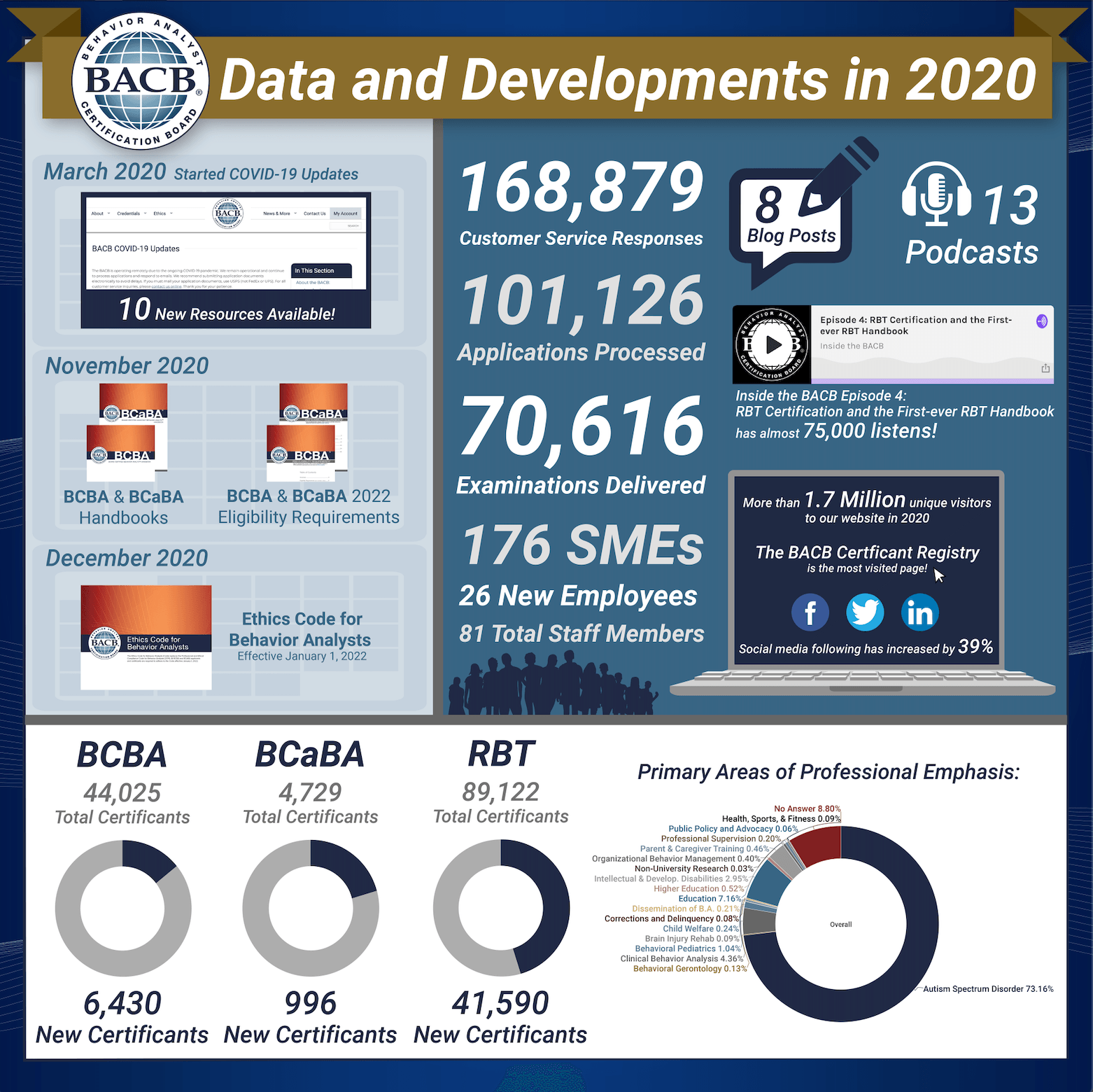
The BACB is pleased to share BACB Data and Developments in 2020, a new video with an accompanying infographic. This video recaps 2020 at the BACB, touching on important changes, milestones, and data points. Check it out to see just how much the practice of ABA is growing. And don’t forget to view the infographic for a concise summary of last year’s most important data points.

Happy New Year, and thank you for your dedication to ABA!

Introduction to the Ethics Code for Behavior Analysts

Inside the BACB: Episode 15

Introduction to the Ethics Code for Behavior AnalystsIn this episode of Inside the BACB, join CEO Dr. Jim Carr and Director of Ethics Dr. Tyra Sellers as they discuss the Ethics Code for Behavior Analysts, an updated ethics Code for BCBAs and BCaBAs. Listen now to get the inside scoop on the revision process, important additions to the Code, and more.

You can find all of the BACB’s videos on our YouTube channel.

The Professional Infrastructure of Applied Behavior Analysis

The Professional Infrastructure of Applied Behavior Analysis

By the BACB

This educational resource breaks down the different elements of the applied behavior analysis profession—and how the BACB and other organizations operate within it.

You can find all of the BACB’s videos on our BACB Videos web page or our YouTube channel.

Tips for a Smooth RBT Certification Application

Note: The information in this blog may be outdated. Please see the 5 Must-Know RBT Application Tips blog post for up-to-date information.

So, you’ve decided to take your career to the next level and pursue certification as a Registered Behavior Technician, or RBT.

Congratulations! We’re rooting for your success, so we’ve put together some tips that will make the RBT application process as quick and simple as possible.

Tip #1: Read the RBT Handbook in full


This isn’t your everyday Terms of Service agreement.

Before completing your RBT application, it’s important to carefully review the RBT Handbook in full. In fact, we suggest that you review the handbook with the person who will become your RBT Supervisor or RBT Requirements Coordinator, as they will also be involved in the application process.

The RBT Handbook is a vital resource for potential RBT applicants because, among other relevant information, it includes:

  • a detailed description of the requirements you must meet to become certified
  • an overview of the application process
  • the documents that are required when applying

The RBT Handbook should be your go-to resource when applying to sit for the RBT certification examination. If you take the time to review it in advance, you’ll become familiar with each requirement and every nitty-gritty detail, which can only mean one thing: smooth sailing ahead!

Tip #2: Create your BACB account yourself


We get by with a little help from our friends—just not while making our BACB accounts.

Be sure to create your BACB account yourself with your personal email address. Do not have anyone, including your future RBT Supervisor or employer, create your account on your behalf. Also refrain from using your work or school email address when signing up, as you may lose access to your BACB account if you lose access to that email address.

When you create your own BACB account with a personal email address, you will have full access to and control over your account when it’s time to renew your certification down the road. Your BACB account is the doorway to your certification, and that certification belongs to you and you alone!

Tip #3: Thoroughly review your application documentation


Don’t let these be your famous last words: “It’ll be fine. I don’t need to double check!”


Before you click submit, it’s important to double check that your application meets all the documentation requirements expected of RBT candidates. As stated earlier, it’s a good idea to review your application with your future RBT Supervisor. Another set of eyes will help ensure that all the documentation requirements are properly met.

Unfortunately, the BACB has been receiving a high volume of applications with documentation that fails to meet the proper requirements. Here are a few reminders based on the most frequent issues we’re seeing:

  • Upload the correct documents into the RBT application and make sure that all necessary pages are included.
  • Check that your RBT 40-hour training certificate includes this statement: “This training program was based on the RBT Task List (2nd ed.) and is designed to meet the 40-hour training requirement for RBT certification. The program is offered independent of the BACB.”
  • Complete the Initial Competency Assessment within 90 days of submitting your application payment. In this form, make sure that the assessor (and/or assistant assessor):
    • completes all applicable fields (e.g., your name, assessor’s name),
    • initials all applicable tasks,
    • indicates how each task was assessed, and
    • signs according to the Acceptable Signatures Policy.

Here are a few reminders that only apply in certain circumstances:

  • If the Responsible Assessor for your Initial Competency Assessment determined that the “with a client” waiver was applicable to you during the COVID-19 pandemic, please make sure to merge your COVID-19 attestation and Initial Competency Assessment into one PDF before submitting.
  • If the documentation that shows you have met the education requirements is in another language, please make sure to have it officially translated into English before submitting.

In the mad dash to submit your application, it’s easy to accidentally forget a document, statement, or signature. But, if information is missing from your application or if the provided documentation doesn’t indicate that you meet the necessary requirements, you may experience delays beyond the standard two-week processing time.

We recognize how important it is to move through the application process quickly so that you can become certified and move forward in your career. That’s why it’s vital to double check that your documentation is complete and meets the appropriate requirements for RBT candidates. That way, we can send you off to sit for the RBT examination as soon as possible!

To view current application processing times, please visit the Customer Service Updates page on the BACB’s website.

Tip #4: Hang in there


The path to certification can be stressful and difficult at times, but being fully prepared can ease the pressure. If you take this advice and reach out to your supervisor for additional support when you need it, the application process will feel relatively painless and far less daunting. We sincerely hope that these tips improve your RBT certification application experience. Best of luck, future RBT!